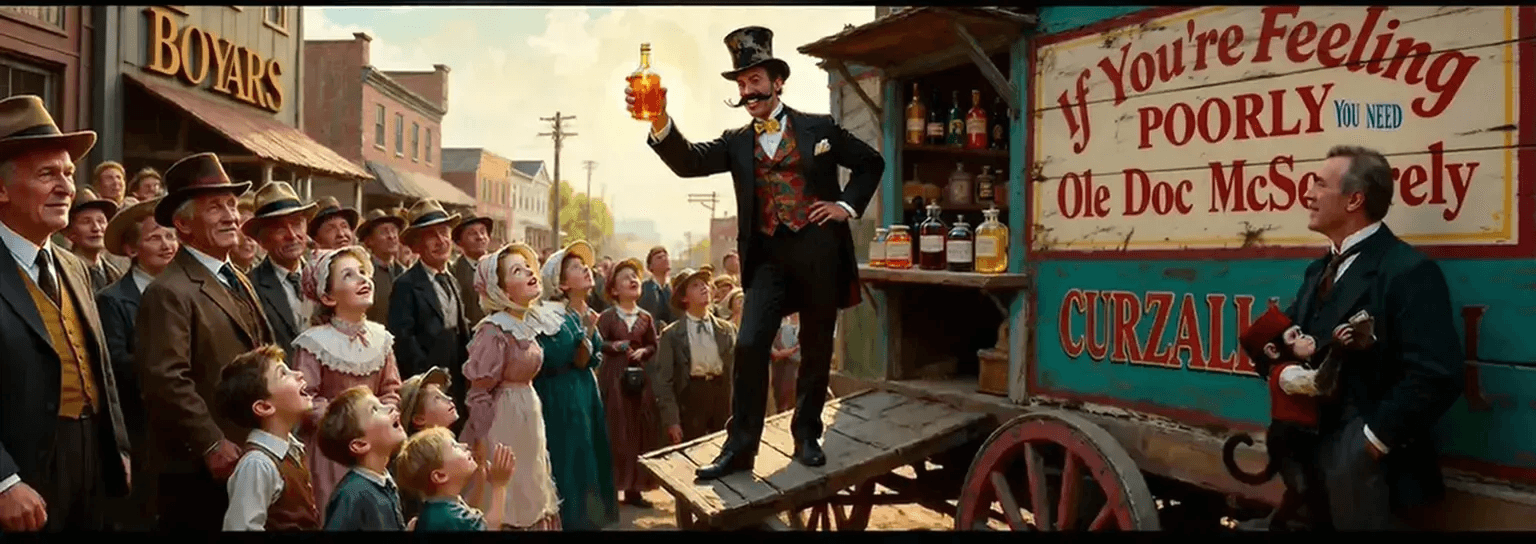
The Snake Oil Salesman Never Left Town
The phrase "snake oil" comes from a real man, a real product, and a real federal case in 1917. Here is the true history of health fraud, and why its oldest playbook is thriving on your supplement shelf today.
Most people under forty know "snake oil" only as an insult, or as a gag in an old Western, the slick peddler in the checkered suit, run out of town before the credits roll. What almost no one knows is that he was real. There was an actual product, an actual con man, and an actual federal case that gave us the phrase. And the playbook he wrote in the 1890s is, almost line for line, the one running on your supplement shelf today.
There Was Real Snake Oil, and It Actually Worked
Here is the twist that makes the whole story rich: genuine snake oil was a legitimate remedy. Chinese laborers who came to build America's Transcontinental Railroad in the 1860s brought oil rendered from the Chinese water snake, which they rubbed on aching joints after brutal days of work. Modern analysis shows why it helped, Chinese water snake oil is unusually rich in omega-3 fatty acids, genuine anti-inflammatories. Shared with American coworkers, its reputation spread. The problem was never the original article. The problem was who noticed how well it sold.
Enter Clark Stanley, the "Rattlesnake King"
In 1893, at the Chicago World's Fair, a former cowboy named Clark Stanley put on a show. He pulled a live rattlesnake from a sack, killed it in front of the crowd, and plunged it into boiling water, theater meant to "prove" the potency of Stanley's Snake Oil Liniment. It was a sensation. He sold it by the wagonload for decades, promising relief from rheumatism, neuralgia, sciatica, toothache, sprains, and more, one bottle, a dozen ailments.
There was only one problem. When federal investigators finally tested Stanley's Snake Oil in 1917 under the new Pure Food and Drug Act, they found it contained no snake oil at all. It was mostly mineral oil, with a little beef fat, red pepper, and turpentine. The "Rattlesnake King" was fined twenty dollars, about five hundred dollars in today's money. That penalty, almost insultingly small, is the moment "snake oil" stopped meaning a remedy and started meaning a lie.
The original con was not selling a bad product. It was taking something that genuinely worked, stripping out everything real, and selling the story instead. That substitution, the appearance of medicine in place of the medicine, is the entire trade, then and now.
Why He Never Actually Left
You would think federal regulation would have ended him. For prescription drugs, it largely did, the FDA now requires proof of safety and effectiveness before a drug reaches you. But in 1994, a law called the Dietary Supplement Health and Education Act (DSHEA) carved out a separate set of rules for supplements. Under DSHEA, supplements are regulated more like food than medicine. A company does not have to prove a supplement works, or even that it does what the label implies, before selling it.
That single carve-out is why your supplement bottle carries a curious sentence in small type: "These statements have not been evaluated by the Food and Drug Administration. This product is not intended to diagnose, treat, cure, or prevent any disease." Read it again. The label is quietly admitting it makes no medical claim at all, while the marketing around it implies the opposite. It is the modern equivalent of Stanley's rattlesnake: a piece of theater that lets the real disclaimer hide in plain sight. Notice how the glossy videos never open with that line.
How to Spot the Modern Coach
The wagon is gone, but the tells are remarkably consistent. The con has always leaned on the same handful of moves:
- ✓The cure-all. One product promising to fix energy, sleep, focus, immunity, joints, and mood at once. Real interventions are specific; miracles are vague.
- ✓The proprietary blend. An ingredient list that hides individual doses behind a trademarked name, so you cannot tell whether there is a meaningful amount of anything.
- ✓The meaningless seal. Official-looking badges that certify nothing verifiable, the direct descendant of Stanley's stage show.
- ✓Manufactured urgency. "Limited supply," "while it lasts," "the formula they do not want you to have." Scarcity is a sales tactic, not a scientific finding.
- ✓Borrowed authority. A lab coat, a "doctor formulated" stamp, a celebrity face, anything that supplies the trust the evidence cannot.
The Seal Was Always the Answer
There is a reason the early twentieth century did not just produce regulation, it produced the seal. When consumers could not personally test every claim, independent bodies stepped in to do it for them. The Good Housekeeping Seal of Approval, first issued in 1909, worked precisely because it sat outside the sale: it had no stake in whether you bought any particular jar, only in whether the jar was honest. Trust became something a third party verified, not something a salesman asserted.
That is the idea Nufound was built to carry into the longevity era. The genuine article is still out there, real science, real practitioners, products that actually do what they say. It simply sits on the same shelf as the tonic, in packaging you cannot tell apart. Our job is the old job, modernized: to test what is real, name what is not, and run the charlatan out of town, so the good that remains can finally be trusted again.
You should never have to take the pitch on faith. That was true in 1893, and it is true on every wellness website open in another tab right now. The remedy has not changed either: independent verification, with no stake in the sale.


Nufound Membership
Get the full picture
Insider members get access to our full evidence-based guide library, clinical evaluation archives, and the bi-weekly Longevity Brief.
Explore Membership